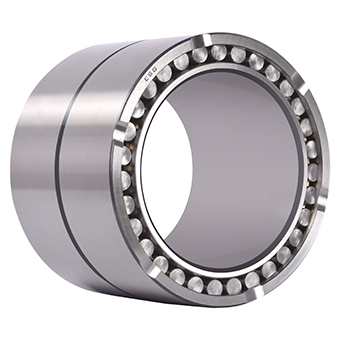
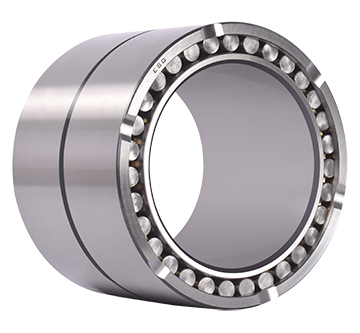
Four-row cylindrical Roller Bearing

Four-row cylindrical roller bearings are mostly used in steel mill industry. ESG Bearing is using our experience, technology, expertise and commitment of quality to make the most suitable bearings for rolling mills.


Best radial cylindrical roller bearings FC3448130 suppliers

Applications
roll neck bearings on roll mill stands,
applicable from roughing, intermediate,
to finishing mill stands,
mainly used in steel mills of billets,
bars, wire rods, sections, and flats, etc. ,

Working Condition
high radial load, and high temperature,
contamination of debris, dust, and water,
consistent impact and vibration,

four-row cylindrical roller bearing

Features
inter rings interchangeable with outer rings to reduce downtime and maintenance costs
more durable and longer working life with selective bearing steel
special heat treatment processing enhancing higher impact resistance and wear resistance
P6 tolerance and sugaring finishing, resulting in higher running accuracy
100% flaw detection avoiding defect causing mill lockdown


Four row cylindrical roller bearings

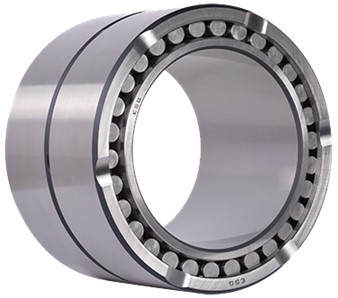
Four row cylindrical roller bearings are mainly used in cold/hot rolling mill,bloomer and other steel rolling mill machines.The bearing structure is separate structure. The bearing rings and rollers can be separated easily. So it is convenient for bearing cleaning, checking, mounting and unmounting jobs.


FC model bearing is consist of two outer rings and one inner ring. On the both sides of outer rings, there are blocker,middle blocker on the middle of the blocker. There is no blocker on the inner rings.


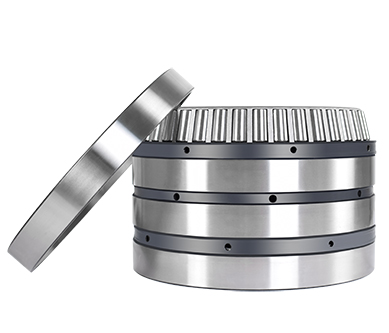
FCD model bearings consist of two pieces of NN model bearings..

FC model and FCD model bearings can allow the axial movement within the axis base to two directions. So, this kind of bearing are suitable for movable end bearings.

Four row cylindrical roller bearins for steel rolling mill

As critical roller bearing of rolling mill, the spare parts of four row cylindrical roller bearings can be replaced, installed, dismounted and cleaned easily. Within the radial installation area, it can provide max. radial loading ability with lower friction factor.


There are three kinds of structure type: FC type, FCD type and FCDP type.


FC Type

It belongs to separable bearings that inner ring can be seperated from the whole bearings. It has better limit rotation speed and can be interchangable. Protection cage can be brass or steel cages.


FCD Type

It belongs to separable bearing. However FCDP type will be much convenient than FCD type for separable degree. For FCD type, it can only make two inner rings separate from the whole bearing with higher limit rotation speed and interchangable feature. Protection cage can be brass or steel cages.


FCDP Type

It is critical roller bearing. The spare parts can be separable with high precision. It is very convenient to install, dismount and clean. Within installation area, it can provide max. radial load ability with lower friction factor. So it is applied in high speed, heavy load and terible working environment of rolling mill production.


Installation method of inner ring of four-row cylindrical roller bearing | Esgbearing.com

The inner ring and roller neck of four row cylindrical roller bearing should be interference fit. When installed, it should be heated to 80 ~ 90 ℃ and the temperature should not exceed 100 ℃. Otherwise, it is easy to cause annealing of bearing ring raceway and roller, affect hardness and wear resistance, and lead to bearing life reduction and premature scrapping. After the bearing is installed on the shaft, the inner ring must be pressed down immediately until it cools down. It is usually heated by induction heater, and it is forbidden to use cutting gun to bake. When the inner ring is installed on the roll neck, it is in close contact with the water retaining ring to prevent the water retaining ring from moving.

Four-row Cylindrical Roller Bearing supplier & manufacturer

Our(ESG Bearings) four row Cylindrical Roller Bearing product awarded with national patent. All products awarded the ISO9001 quality management system certification for many times.

Roll Neck Bearings | Esgbearing.com

Generally speaking, the rolling mill stands will have 2 rolls, 3 rolls, 4 rolls, or a set of multiple rolls mounted onto the stands.  The loads on the rolls will transfer to the roll neck bearings and their housings during the rolling of steels. The roll neck bearings are to meet the basic need of the smooth rolling of steel products. They will differ from sizes, carrying capacities and other aspects, due to different requirements and working conditions. Therefore, they will have different configurations and speeds of rolling.

Roll neck bearings


The bearings are designed to withstand high loads, impacts, varying speeds and high temperature. They also need to work with metal particles, dirt, and water. Therefore, the bearings should be made with good material and technique to endure the toughest working conditions. Roll neck bearings with high quality will help steel mills reduce a lot for reducing power consumption, downtime, and improving rolling conditions.

four-row cylindrical roller bearings FC3854200


With best bearing material choosing, and strict control on processing, ESG Bearing is able to meet most modern steel mills’ high requirements. ESG Bearing is also the only 1 factory bearing manufacturers having 100% flaw detection on the bearings. Thus the bearing quality will be assured.


roll neck bearings

Steel metal rolling operations usually deform the materials by compressive forces between two constantly spinning rolls. These forces act to reduce the thickness of the metal and change its grain structure. Besides, the rolls will also feed the material when they are spinning to each other.


However, the rolls cannot function in isolation. During the rolling process, rolls, stands, bearings, housings, and motors are necessary parts for the operation. Usually, bearings will transmit motion and forces. They are usually mounted on the rolls and inserted into the housings. This is why the bearings on the mill stands are called roll neck bearings. These bearings should be strong enough to face with extreme temperatures, dust, contaminants, and variable humidity. They will also work under physical stresses of continuous high speed, extreme torque and shock loads.

Roller Bearing Material Specification (First Part)

Rolling bearings are mainly composed of high carbon chromium bearing steel.High-carbon chromium bearing steel is also called fully hardenable steel with the same inside and outside hardness. It is widely used in many industries with bigger quantity, over 80% of the total material.


1.GCr15

Feature and application:It can be applied in many industries with big quantity in Martensite and bainite quenching.

Technical specification:Effective wall thickness under 26mm,extra light and narrow series less than 16mm,Quenching and tempering hardness HRC57~62.


2.GCr15SiMn

Feature and application:it can be applied in many industrial with big-size bearings in Martensite quenching.

Technical specification:effective wall thickness thicker than 26mm,extra light and narrow series more than 16mm,quenching and tempering hardness HRC57~62.


3.GCr18Mo

Feature and application:bainite steel, used in wear resistant occasion with bainite quenching.

Technical specification:effective wall thickness within 26~48mm, extra light and narrow series less than 16mm, quenching and tempering hardness HRC57~62,bainite is more wear than martensite, better for wear resistant occasion.


Rolling Mill Bearing Material Characteristics (SECOND PART)

Carburized bearing steel is also called semi-hardenable steel, which is soft inside and hard outside. The material has a certain degree of "elasticity" for impact resistance. It needs to be carburized and quenched, and the process is more complicated.


G20Cr2Ni4A

Features and uses: used in impact-resistant occasions, medium and large bearings, and can be deeply carburized.


Technical characteristics: The effective carburizing layer can be deeper than 2.5mm, and the surface quenching and tempering hardness is HRC58~63.


Bearing parts made of this type of steel have high hardness (hardness ≥ HRC58), certain wear resistance and high contact fatigue resistance after heat treatment processes such as carburization, quenching and tempering, and guarantee The heart has good toughness (hardness HRC33-48). This surface hardened core has the characteristics of toughness, making the carburized bearing steel particularly suitable for stable operation under conditions of large impact loads.


After carburizing and quenching, the surface retains the state of compressive stress and has good fatigue resistance. It has strong ability to bear impact load, and the surface hardened layer has micro cracks and it is not easy to expand to the inside. The surface has a higher hardness and the core hardness is lower. Compared with high carbon chromium bearing steel, it has better core impact toughness. The depth and concentration of carburization can be adjusted as required.


However, the cost of bearings made of G20CrNi4A is relatively high, and in the use of small and medium-sized bearings, their life will not be greatly improved compared with bearing steel. Therefore, only carburized steel is used for medium and large bearings.


FOXBORO,FBM216B P0927AJ Redundant HART® Communication Input Module

Innovative Redundancy for Unbroken Data

In modern industries—chemical processing, power generation, oil & gas—continuous access to reliable field data is non-negotiable.

The FBM216B P0927AJ features dual-channel HART® inputs. If one channel fails, traffic seamlessly switches to the backup, guaranteeing 99.9% uptime even under harsh conditions.

This hardware-level redundancy outperforms software-only solutions, cutting unplanned data gaps by 25% on average.


Smart Diagnostics at Your Fingertips

Beyond redundant pathways, the module embeds real-time loop health monitoring. Engineers receive instantaneous alerts on signal noise, device drift, or wiring anomalies—enabling predictive maintenance that can reduce emergency field visits by 30% and extend calibration intervals by up to 20%.


Simplified Maintenance with Hot-Swap Capability

Designed for efficiency, the FBM216B P0927AJ supports hot-swappable installation. Maintenance teams can replace a faulty card in under one minute—without shutting down the entire rack.

Field trials report a 50% reduction in mean time to repair (MTTR), translating directly into higher overall plant availability.


Proven Performance in Extreme Environments

Field deployments in coastal refineries and desert power stations confirm the module’s resilience:

· Temperature Range: Stable operation from –40 °C to +70 °C

· Shock & Vibration: Certified to IEC standards for offshore platforms

· EMI Immunity: Withstands industrial-grade electromagnetic interference

This robustness ensures data integrity across continents and conditions, supporting operators in making timely, informed decisions.


Real-World Impact & Statistics

· 78% of process automation managers now rate redundant communication a top-three priority when upgrading DCS hardware.

· Early adopters of FBM216B P0927AJ report a 15% improvement in loop response times.

· Plants using the module have seen a 20% drop in unscheduled shutdowns tied to field instrument faults.

These figures highlight the module’s capacity to strengthen operational continuity, safety, and regulatory compliance.


Applications Across Industries

· Chemical & Petrochemical: Precise monitoring of reactor temperature and pressure loops

· Power & Utilities: Fuel-gas ratio control and boiler instrumentation data collection

· Oil & Gas: Redundant capture of well-head flow and valve position signals

· Pharmaceutical & Food: Hygienic process loop monitoring to meet strict quality standards

Whether integrating into new installations or retrofitting legacy racks, the FBM216B P0927AJ adapts seamlessly to existing HART® networks.


About Foxboro & Amikon Limited

Foxboro is a pioneer in DCS innovation with over 80 years of automation expertise. Its solutions have powered thousands of plants worldwide, delivering precision control and unmatched reliability.

Amikon Limited specializes in providing up-to-date industry news and insights on automation components. For enquiries about the FBM216B P0927AJ or to schedule a product demonstration, please contact May at sales5@amikon.cn.


Related Models
Model

Description

FBM217 P0914TR

Dual-channel digital input module

FBM215

Single-channel analog output module

FBM214B P0927AH

Redundant HART® input module

FBM207B

Temperature loop isolation module

FBM206

4–20 mA universal input module

FBM205 P0914XG

Thermocouple input terminal

FBM203 P0914SV

Resistance sensor input module

FBM202 P0926EQ

Thermocouple/RTD hybrid input

FBM202 P0914ST

HART® smart input module

FBM2/36 P0500RG

Dual high-speed digital input


Yokogawa DX11*A S9081BE-0 Duplex Control Card Enables High-Reliability Industrial Control Systems

As industrial control systems continue to develop towards high complexity and critical task processing, the system has put forward higher requirements for hardware modules with high reliability and strong redundancy. The DX11*A S9081BE-0 duplex control card launched by Yokogawa is a key control component designed for high-availability scenarios. It plays the role of redundant control interface in the Yokogawa DCS system, effectively improving the system's continuous operation capability, and is widely used in industries such as oil and gas, petrochemicals, and electricity that have extremely high requirements for control continuity.


Advanced redundant control architecture

The most notable feature of DX11*A S9081BE-0 is its duplex architecture design. The control card supports active and standby dual-path control signal transmission. When the main channel fails, the system can automatically switch to the standby channel to ensure uninterrupted communication with the field I/O module. This redundant structure greatly improves the fault tolerance of the control system.

The control card can monitor the operating status of the two channels in real time. Once an abnormality is detected in the main channel, it will automatically switch without manual intervention, thus achieving high availability and continuous operation guarantee of the control system.


Seamless collaboration with Yokogawa DCS system

The card is tailored for Yokogawa control systems (such as CENTUM VP) and can be seamlessly connected to FCS control stations and I/O buses. It communicates with other modules through high-speed serial or parallel buses to achieve high-frequency data exchange, meeting the real-time and synchronization required for process control.

At the same time, the control card supports a variety of diagnostic and status reporting functions, and operators can monitor its working status in real time, quickly identify and locate fault points, thereby shortening maintenance time. This design not only improves the maintainability of the system, but also enhances the control of the operating engineer over the system operation.


Stable operation in complex industrial environments

DX11*A S9081BE-0 adopts industrial-grade design standards and can operate stably in industrial sites with high temperature, high humidity, strong electromagnetic interference and frequent vibration. The card body uses anti-interference and high-insulation components and has undergone multiple rigorous tests to ensure stable performance in harsh environments.

In addition, the card is equipped with a voltage mutation protection circuit to effectively resist electrical shock. High resistance to external interference makes it a reliable guarantee in automation environments with extremely high requirements for safety and stability.


In today's industrial automation field, redundant design has become a standard configuration for key systems. Yokogawa DX11*A S9081BE-0 duplex control card, with its dual-path communication architecture, excellent DCS system integration capabilities and strong environmental adaptability, is being adopted by more and more key industries. In the future, as the degree of automation continues to increase, such high-reliability control modules will play a more important role in the construction of smart factories.